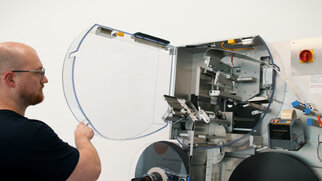
The shortage of skilled workers, rising personnel costs, and the desire for maximum system availability are increasing the pressure to automate, even in packaging labeling. With the HERMA AutoSplicer, roll changes in the labeling process can be managed without interruption—for the first time, even for label rolls whose web is firmly attached to the roll core. This is made possible by a new optional cutting system, with which HERMA is expanding the scope of application for its automatic roll-change solution. A practical example calculation from HERMA illustrates the productivity potential offered by uninterrupted roll changes: With ten roll changes per shift and an average changeover time of three minutes, manual roll changes result in 30 minutes of downtime per shift. In a three-shift operation, this adds up to about 90 minutes per day. “With 47 production weeks, this can amount to more than 350 hours per year,” says Max Kunert, Head of Project and Product Management at HERMA. “The actual savings naturally depend on the production speed, the roll size, and the specific system configuration. However, the example shows how quickly regularly recurring interruptions can become a significant factor affecting productivity.”
Controlled Cutting Without Manual Intervention
The HERMA AutoSplicer features two roll unwinder. While the label web from one roll is being processed, the second roll is already ready for the next changeover. As the active roll nears its end, the system automatically splices its web to the prepared label web of the reserve roll. Meanwhile, the labeling process continues uninterrupted. Afterward, the operator can replace the empty roll and prepare the roll unwinder for the next changeover.
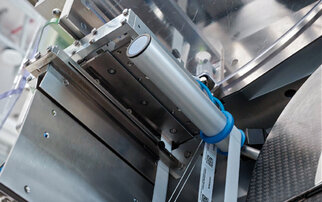
Previously, this process required the label web to detach itself from the core at the end of the roll. This is possible with rolls where the web is not attached to the core. With other roll designs, however, the label web is firmly connected to the core. Allowing the web to run out completely can lead to unwanted tension and cause the web to become damaged or tear. This is precisely where the new cutting system comes into play: It cuts the label web in a controlled manner without manual intervention before the roll is completely used up. This allows the AutoSplicer to perform the roll change without interruption, even with webs that are firmly attached to the core. Since the cutting system is required only for these roll designs, HERMA offers it as an option. In addition, operators benefit from noticeably simpler machine control and optimal process visualization, thanks to the newly integrated, custom-designed HMI system and the intuitive GUI design.
Standardized Workflows for More Stable Processes
“Manufacturing companies must use their equipment as efficiently as possible while at the same time relieving their employees of repetitive routine tasks,” says Kunert. “The new cutting system expands the AutoSplicer’s range of applications and now automates the roll change regardless of whether the web detaches from the core on its own.” Automated roll changes standardize processes, reduce manual intervention, and improve production planning. This advantage is particularly significant in high-performance labeling lines with featuring high web speeds and frequent roll changes. The AutoSplicer is designed for such applications: Even at web speeds exceeding 110 meters per minute, the splicing technology ensures a secure connection of the label webs and a stable, material-friendly process. The HERMA AutoSplicer handles paper and film labels as well as transparent or multi-layer label materials. The HERMA AutoSplicer can also be easily integrated into existing labeling systems and thus flexibly adapted to various production environments. Extensive modifications or time-consuming training are generally not required. “The AutoSplicer with the new cutting system demonstrates how HERMA takes a holistic view of the entire labeling process,” emphasizes Max Kunert. “Our goal is to consistently automate not only the actual labeling, but also the material feed and related handling processes.”